
India's newly formed Artificial Intelligence Governance and Economic Group (AIGEG) is set to advocate for a unified legal framework for AI companies, including developers of large language models and chatbot systems, alongside broader operational rules.

Under the defence partnership, India and the UAE are eyeing defence industrial collaboration and cooperation in advanced technologies, cyberspace training, special operations, interoperability of their militaries and counter terrorism.
Following through announcements with enforcement of measures is key, as a run through recent Indian economic history shows, points out A K Bhattacharya.

Over the years, India-EU ties have grown, and covered trade, investment, climate change, science and technology, space, digital, mobility, and connectivity.

Andhra Pradesh is spearheading an ambitious initiative to establish a fully integrated beach sand minerals, rare earth, and titanium ecosystem, aiming to attract over 50,000 crore in investments over the next decade. This move is part of India's broader strategy to reduce its reliance on China for strategic minerals and permanent magnets, with the state preparing a comprehensive rare earth policy and planning specialised industrial clusters.

A senior US official has emphasised India's crucial role in maintaining peace and stability in the Indo-Pacific region and ensuring a balanced power dynamic in Asia, advocating for stronger defence ties between the two nations.

In a region increasingly shaped by competition and coercion, such collaboration strengthens security without confrontation, builds capacity without dependency and promotes order without domination, points out Dr Kumar.
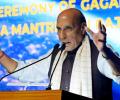
Defence Minister Rajnath Singh has emphasised the need for India to develop a robust drone manufacturing ecosystem to enhance its defence capabilities, drawing lessons from recent global conflicts.

'In India's case, an extended earnings slowdown accompanied by rich valuations have dimmed returns since late 2024.'

The measures announced by it risk backfiring, disrupting the foreign exchange market, and intensifying the very pressures they seek to contain, with broader consequences for the economy points out Rajeswari Sengupta.

'It was diminishing even before Trump came to power.' 'The US was at the centre of the global economy. That position is going to become less and less important and less central.'
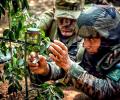
The Defence Research and Development Organisation (DRDO) has transferred seven technologies developed under the Technology Development Fund (TDF) scheme to the armed forces, enhancing indigenous defense capabilities.

US President Donald Trump's call to Prime Minister Narendra Modi signals a concerted effort to reset strained Washington-New Delhi ties, with a focus on 'big-ticket' energy and trade deals, including increased Indian imports of US LNG and LPG, and potential cooperation on small modular reactors.

We cannot simply have a 60-65 per cent import dependency in LPG, the bulk of which comes from just one volatile region -- West Asia, points out R Jagannathan.

The intriguing bit is that Trump is likely to attend the talks in Islamabad this weekend -- if he does, it will be the clearest signal yet that the US is ready to exit the war with some sort of win to show, since he cannot afford to go for the talks and return empty-handed, notes Prem Panicker in his must read blog on the Iran War

It is time for India to step up and get Russia, China and Europe to agree to a joint appeal to all combatants. Time is of essence, tomorrow may be too late, asserts Colonel Anil A Athale, former head of the history division, ministry of defence.

Singh made the remarks while addressing a "CEOs' Roundtable" at the 14th edition of Aero India at the Yelahanka Air Force station complex on the outskirts of Bengaluru.

Pakistan's Prime Minister Shehbaz Sharif has offered to host talks between the US and Iran to help resolve the ongoing conflict in the Middle East, following reports of Pakistan's involvement in backchannel diplomacy.
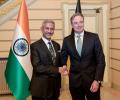
The era where nations thrived through rigid alignments is giving way to an age where the connective State defines power. For India, that era has arrived, points out Dr Nishakant Ojha.

The conflict may disrupt Budget 2026-2027 projections, squeezing revenues and raising subsidies, prompting fiscal adjustments and potential reforms, echoing lessons from the Covid-era shock, points out A K Bhattacharya.
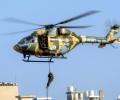
'The tools of warfare are changing. The MoD must deepen its engagement with technology thinkers that can present compelling visions of where warfare may be heading.'

The Dhurandhar movies will undoubtedly shape the minds of the audience much more than news reports, court investigations, books and documentaries. But it is worth remembering that Pakistan's irridentist claims against India's national security have succeeded due to strategic planning, diplomacy, and the unsung heroines and heroes across government agencies, not due to a single maverick leader, points out Shweta Desai.But it is worth to remember that Pakistan's irredentist claims against India's national security have succeeded due to strategic planning, diplomacy, and the unsung heroines and heroes across government agencies -- not a single maverick, points out Shweta Desai.

European Commission President Ursula von der Leyen says India and the EU are close to a 'historic trade agreement' that could create a market of two billion people and account for almost a quarter of the global GDP.
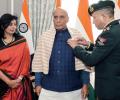
Defence Minister Rajnath Singh lauds the armed forces' restrained response during Operation Sindoor after the Pahalgam terror attack, highlighting coordination and improved connectivity in border areas.

Trump's outburst comes amid escalating tensions between the US and its northern neighbour, following recent remarks by Canadian Prime Minister Mark Carney at the World Economic Forum (WEF) in Davos.

The Indian government informed Parliament that India and the US are engaged in negotiations for a mutually beneficial multi-sectoral bilateral trade agreement. The two countries also cooperate on strategic, economic, and defense matters, managing divergences through high-level dialogues.

Trump has made it clear: the US will not lift its blockade of Iranian ports until a deal is signed.

The fiscal tilt towards capex benefits companies in investment-related sectors like capital goods, defence equipment, engineering & construction and metal & mining. The planned cut in revenue expenditure will weigh on companies in consumption sectors like FMCG, consumer durables and retail.

'We were in a heavily nuclearised environment. China had tested for Pakistan in the 1980s and helped their missile programme stay just one step behind us.'

The purge in Washington does not pause the war. Strikes continue, Hormuz remains closed, and Brent crude is still dancing around $109 a barrel. For India, the command chaos in the Pentagon is another layer of uncertainty piled on five weeks of conflict that was already straining every buffer Delhi has.
Commerce ministry had recently brought out a discussion paper that called for allowing 100 per cent FDI in the defence sector.

Makers of spirits, beer, and wine are working to identify new markets of growth as two of the industry's biggest liquor markets, Maharashtra and Telangana, remain embroiled in taxation and payment issues.
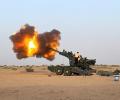
Neither the BJP, nor the Congress before it, made any manifesto commitments on defence spending, even though allocations have plummeted from 4 per cent of gross domestic product (GDP) in the late 1980s to less than 2 per cent today, points out Ajai Shukla.

The delegations from the US and Iran head to Islamabad on Friday, carrying a ceasefire that is already fraying, a Strait that is technically open and practically closed, and a negotiating agenda that would challenge even parties actually negotiating in good faith, which these groups are not. Prem Panicker continues his must read blog on the Iran War.

While many areas compete for resources, defence, education, and adaptation deserve focus for maximum impact, suggests Laveesh Bhandari.

'We believe the truth is in the middle, and that India is at an important crossroads.'

The deal shifts the US posture towards India from hostile to neutral, and that matters for growth, points out T T Ram Mohan.

'The procurement cycle still consumes too much time; little has changed.'

For weeks, the war skirted the edge of catastrophe without tipping over. Missiles flew, there was much destruction, commanders were assassinated, cities across the Gulf and even in Israel struggled to absorb the shock. But one line held: Energy infrastructure, the arteries of the global economy, remained largely untouched. That is no longer true. Prem Panicker continues his must read daily blog on the Gulf War.

'I suspect that Bangladesh being given permission stuck in India's official craw, and this story was an attempt to balance the scales by giving the impression that a similar waiver had been given to India as well.'
